
Toket Lab Notes
Toket Lab Notes
Notes from building Toket: product decisions, AI development experiments, and lessons learned.
Notes by Siji Wang, the builder behind Toket.
Latest Lab Notes
Building Toket #013: AI Can Give You an Answer. But Can You Trust It?
From GEO to AI infrastructure research, I’ve become less interested in whether AI can produce an answer—and more interested in where that answer comes from, what evidence supports it, and when a product should simply say, “I don’t know.”
How to Choose an AI Model for Coding: GPT vs Claude vs Gemini
Choosing a coding model means matching the model to the task, then comparing coding quality, context capacity, workflow speed, and cost.
Building Toket #012: Before AI Recommends You, Can It Understand Your Website?
I have been spending a lot of time researching GEO recently, and the deeper I go, the more I feel that many discussions skip a very basic question. Everyone is asking how to get their brand recommended by ChatGPT, DeepSeek, Gemini, and other AI systems. But before recommendation comes something more fundamental: Can AI actually access, identify, and understand your website? That is why I recently built a free Website AI Readiness Check in Toket. It does not predict whether an AI system will recommend a brand, and it does not promise that fixing a few technical issues will improve AI rankings. It starts with something more measurable: crawlability, page structure, canonical signals, structured data, entity relationships, and machine-readable information. The more black-box systems I study, the more I want to start with what can actually be verified.
Building Toket #010: AI Can Write the Code, But It Won’t Decide the Direction
After using AI intensively for coding, architecture cleanup, and report writing, I have become less confident in AI collaboration rather than more confident. The problem is not that AI cannot do the work. The problem is that it is extremely good at continuing whatever direction I give it. If my assumption is wrong, it often implements the wrong direction efficiently. If context is incomplete, it may fill the gaps with something plausible but untrue. And when writing reports, the result is often polished and complete, but obviously AI-generated. AI allows me to do work that previously required several people. But recently I have become much clearer about one thing: Speed can be delegated to AI. Judgment cannot.
Building Toket #009: When an AI Product Learns to Manage Its Own Complexity
Recently, I have spent much less time adding new user-facing features and much more time managing the complexity that Toket accumulated over time. As AI tools, GEO, Workspace, model systems, content architecture, and internal operations continued to grow, Toket became more than a simple experiment. The new challenge became: How do I keep a fast-growing product understandable? How do I prevent legacy logic, temporary solutions, and old decisions from slowing down the future? This update focused on removing legacy complexity, improving architecture boundaries, strengthening release workflows, and making the system protect the product itself. For a solo Builder, the hardest stage is not starting from zero. It is keeping a growing product maintainable.
Building Toket #007: Rebuilding Toket’s Product Foundation
Over the past few months, I have been continuously expanding Toket’s capabilities — from AI cost analysis and Prompt Optimizer to Workspace, GEO, model data, and content systems. But rapid exploration also created new challenges. More pages, more systems, and more decisions from different stages started affecting the product’s long-term direction. This update was not about adding more features. Instead, it focused on rebuilding Toket’s product foundation: Public Shell, brand experience, content architecture, Data Tool experience, Workspace, and code structure. It was a transition from constantly adding capabilities to building a more sustainable product foundation.
Building Toket #006: When an AI Product Needs Its Own Operating System
Over the past few months, I have continuously added new capabilities to Toket: AI tools, Workspace, GEO, knowledge systems, and internal management features. But as the product grew, I realized the biggest challenge was no longer adding more features. It was managing the complexity created by rapid iteration. This update was not about launching another user-facing feature. Instead, I rebuilt Toket’s internal operating structure: redesigning the Admin architecture, creating a unified design system, removing legacy pages, and clarifying data ownership. For a solo Builder, a growing product eventually needs more than features. It needs its own operating system.
The Hardest Part of AI Products Is Productization
After months of building Toket, I have started to rethink what makes AI products difficult. The challenge is not simply creating features, but turning technology into a product that users can understand, trust, and use.
Building Toket: Moving From Exploration Into August Execution
After weeks of exploration, I completed a GEO research cycle and reorganized Toket’s August roadmap. The next stage is moving from exploration into product execution.
Building Toket: Moving an Independent AI Product Into Business Validation
After months of building Toket, the focus is shifting from creating features to validating real value. With GEO becoming a potential product direction, the next challenge is finding the first users and commercial feedback.
Building Toket: Independent Builders Need Rest Too
After months of continuous development, I started thinking about a different challenge of building an independent AI product: not just how fast we can build, but how long we can keep making good decisions.
Building Toket: A Human-AI Collaboration Experiment for Creating an Independent AI Product
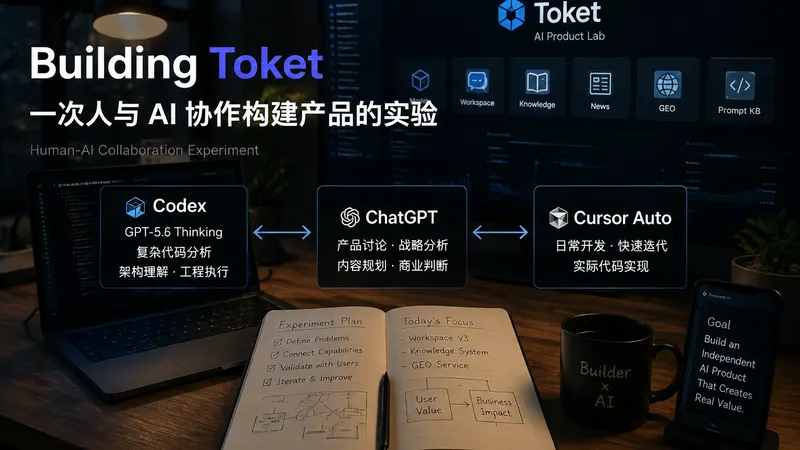
Over the past few months, Toket has evolved from a personal collection of AI tools into an independent AI product laboratory. In August 2026, I started a new experiment: allowing AI to participate more deeply in product decisions, feature planning, and long-term direction while documenting how humans and AI collaborate to build products.
I Used AI to Complain About AI—Then Had to Prove My Account Was My Account
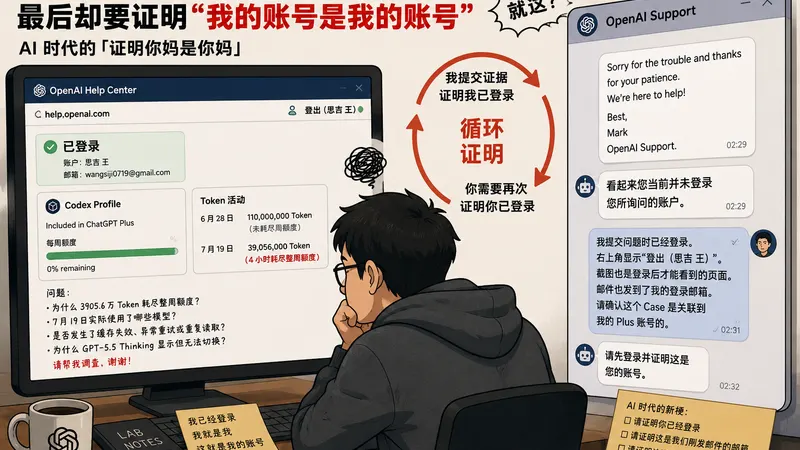
I contacted OpenAI Support to investigate an abnormal Codex usage event. I was signed in, submitted authenticated screenshots, and received the reply at the email address linked to my Plus account. Support still told me it could not confirm that I was signed in to the account in question.
OpenAI Gave Me a Free Month of Plus. I Used a Week’s Allowance in One Afternoon.
ChatGPT Plus used to feel like more than enough for an entire month. Now that ChatGPT and Codex have become my daily development environment for Toket, I can reach a weekly allowance in a single afternoon. The plan may not be the only thing that changed. My relationship with AI did.
After Three Months of Building V3, I Regret Not Studying Mature Open-Source Projects First
I started seriously using AI to write code for Toket in April 2026. Cursor was incredibly fast. Sometimes I woul…
Why I Spent the Entire Day Improving Toket AI
There wasn’t a major feature launch today. Instead, I spent the day rebuilding Toket AI. As AI products evolve from chatbots into workspaces, I realized the future isn’t about adding more features—it’s about building better workflows.
No Lab Notes published yet.